Three variables decide most restorative material calls: how much load the unit will carry, how visible it is, and how much sound tooth structure is left. Everything else is refinement.
Working through these in sequence resolves the majority of cases without needing to compare data sheets. The order matters — strength constrains the aesthetic options, not the reverse.
Start with the occlusion, not the shade. A first molar in a patient with documented parafunction, a short clinical crown or a span crossing more than one pontic all point to high-strength zirconia or a cast substructure. Signs worth recording on the prescription: existing wear facets, a history of fractured restorations, a splint in use, or a heavy canine-guided excursion. Where any of these are present, treat the strength requirement as fixed and design the aesthetics within it.
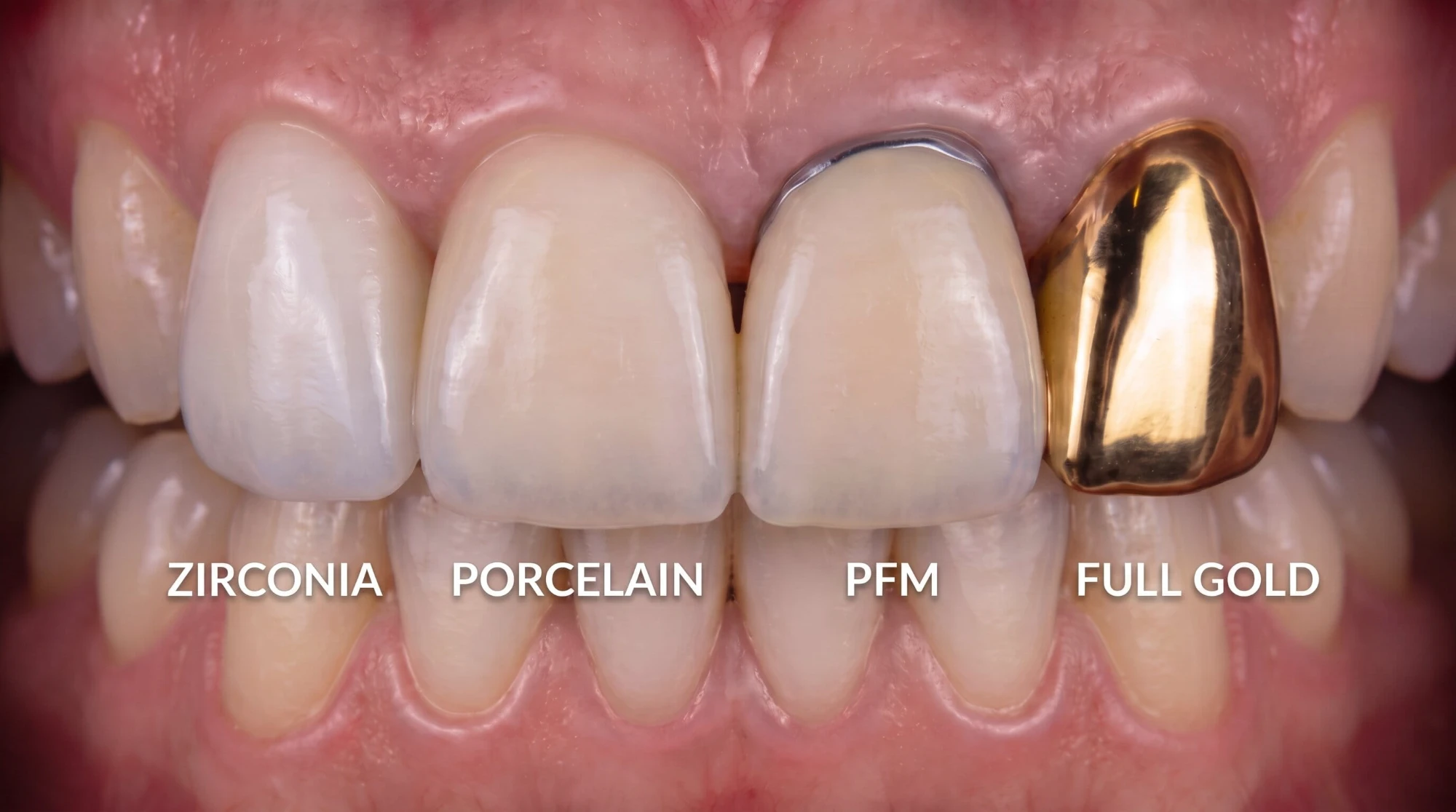
Aesthetic demand is not simply anterior versus posterior — it is what the patient sees and what they will accept. An upper first premolar in a wide smile can be more demanding than a lower central. If the unit sits in the display zone and the load assessment allows it, lithium disilicate gives the closest match to natural enamel because of how it transmits light rather than reflecting off an opaque core. Where strength rules that out, cut-back zirconia layered on the buccal is the compromise that holds up.
Adhesive materials need enamel, or at least a substantial bonded surface, to perform as intended. A heavily restored tooth with deep subgingival margins and little peripheral enamel is a poor candidate for a bonded veneer or a thin onlay, regardless of how good the aesthetic case is. In that situation a conventionally cemented full-coverage restoration is the more predictable outcome — and if the margin cannot be reliably captured, that is a preparation question to resolve before the case is sent.
Our default recommendation by clinical situation. These are starting points, not rules — send the case through if it sits between two rows.
| Clinical Situation | First Choice | Alternative | Note |
|---|---|---|---|
| Posterior single crown | Monolithic zirconia | Lithium disilicate | Minimal reduction; strongest option |
| Anterior single crown | Lithium disilicate | Layered zirconia | Stump shade required |
| Veneers, minimal prep | Lithium disilicate | — | Needs enamel to bond to |
| 3-unit posterior bridge | Zirconia | PFM | Check connector height |
| Long-span bridge | Zirconia or PFM | — | Framework try-in advised |
| Bruxism, posterior | Monolithic zirconia | Full-metal | Avoid layered ceramics |
| Inlay / onlay | Lithium disilicate | Zirconia | Adhesive protocol essential |
| Screw-retained implant bridge | Titanium framework | Zirconia | Verification jig recommended |
| Custom abutment | Titanium | Zirconia | Check emergence profile |
| Removable partial | Chrome cobalt frame | Flexible nylon | Survey before prescribing |
The crystal structure that makes zirconia strong also scatters light. Higher-translucency zirconia formulations narrow the gap but trade some flexural strength to do it. There is no formulation that is simultaneously the strongest and the most lifelike.
Layered ceramic needs space to build depth. If the preparation does not provide it, the layer is thin, the underlying core shows through, and the aesthetic gain that justified the material disappears. Under-reduction is a common cause of a disappointing anterior result.
Minimal-prep work preserves tooth structure but depends entirely on the bond. On a tooth with limited enamel, the conservative option carries more long-term risk than a full-coverage restoration would.
On strength figures. Flexural strength values quoted for these materials vary by formulation, shading and processing, and are drawn from manufacturer technical data. Treat published ranges as comparative rather than absolute, and refer to the instructions for use for the specific product being prescribed.
Send it through with the clinical picture and we will recommend a material before we start. No charge for planning advice.